





Whether you’re watching the Olympics, a college regatta, or tuning into the Henley Royal Regatta, rowing offers a captivating display of synchronized power and endurance. However, the sport comes with its own vocabulary that can leave newcomers feeling adrift. So let’s navigate the essential terminology and appreciate what makes rowing such a demanding and elegant sport.
The Basics: Boats and Equipment
Let’s start with the vessel itself. In rowing, the boat is called a shell, a term that reflects its lightweight construction. Shells are classified by the number of rowers: a single holds one person, a pair has two, a four has four, and an eight carries eight rowers plus a coxswain.
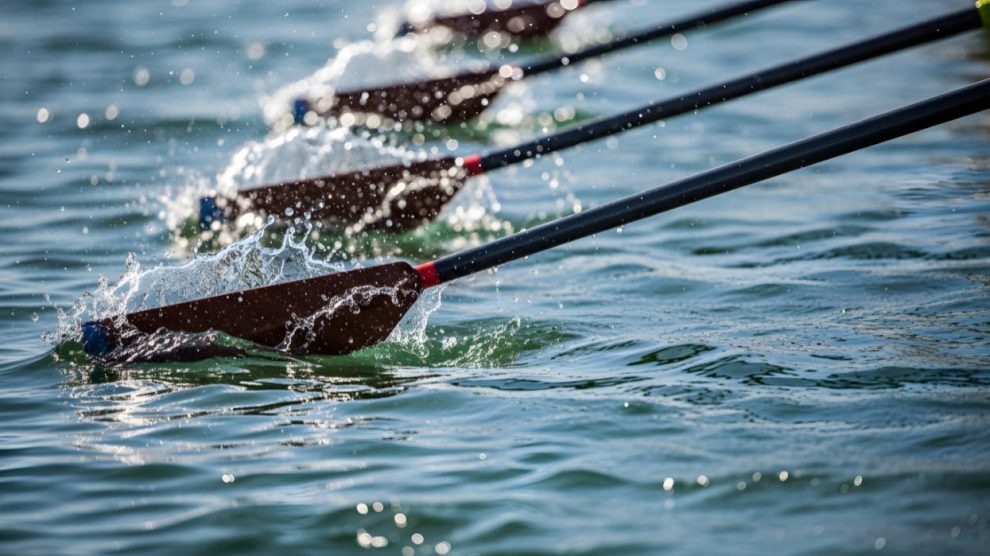
The oar is the rower’s primary tool, and it comes in two varieties. Sweep rowing means each rower handles one oar with both hands, while sculling means each rower uses two oars, one in each hand. When you see boat classifications like “4+” or “2-“, the plus sign indicates a coxswain is aboard, while the minus sign means there isn’t one.
The coxswain (pronounced “cox-in”) is the small, strategically placed crew member who faces forward, steers the boat, and calls out commands and race strategy. In an eight, the cox sits in the stern, while in a coxed four or pair, they often sit in the bow. Don’t let their size fool you—a skilled cox can make the difference between victory and defeat.
Positions and Roles
Rowers are numbered from bow to stern. The bow seat (seat one) is at the front of the boat, while the stroke seat (the highest number) sits closest to the stern and sets the rhythm for the entire crew. The stroke must be technically proficient and mentally tough, as everyone behind them matches their cadence.
The port side is the left side of the boat when facing forward, while starboard is the right side. In sweep rowing, rowers are often referred to by their side: port or starboard. The middle positions in an eight, typically seats four through six, are called the engine room because these rowers are usually the most powerful members of the crew.
The Rowing Stroke
The rowing stroke has four distinct phases. The catch is where the oar blade enters the water, marking the beginning of the drive. The drive is the powerful phase where rowers push with their legs, swing their backs, and pull with their arms to propel the boat forward. The finish is when rowers extract the blade from the water, and the recovery is the phase where rowers return to the catch position, allowing the boat to glide.
Proper technique requires the rower to feather the oar, rotating it so the blade is parallel to the water during recovery. This reduces wind resistance and prevents the blade from catching on waves. Conversely, squaring the blade means rotating it perpendicular to the water just before the catch.
A crab is every rower’s nightmare—it occurs when an oar gets stuck in the water, usually because it wasn’t properly feathered or was released at the wrong angle. A severe crab can stop a boat entirely or even eject a rower from their seat.
Race Formats and Venues
Most rowing races are regattas, organized competitions featuring multiple events. Races typically take place on a course that is 2,000 meters long for standard races and 1,000 meters for shorter sprint events. The racing area is divided into lanes, usually six, each about 13.5 meters wide.
Head races are time trials where boats start at intervals and race against the clock over longer distances, often navigating turns. The famous Head of the Charles in Boston is the world’s largest head race. In contrast, sprint races are side-by-side competitions over straight courses.
At the start, boats are held in position by a stake boat or an official who holds the stern. After the starting command, crews have a few strokes to establish their rhythm before settling into their race pace. Many crews use a power ten or power twenty—a predetermined number of strokes at maximum intensity—to make moves during the race.
Measuring Performance
The rating or stroke rate refers to the number of strokes per minute. During a 2,000-meter race, crews might start at a rating of 40-45 strokes per minute, settle to 34-38 for the body of the race, and then increase again for the sprint finish. Higher ratings don’t always mean faster speeds—efficiency and power matter more than raw cadence.
Split refers to the boat’s pace, measured as the time it would take to cover 500 meters at the current speed. A split of 1:30 means the boat is traveling at a pace that would cover 500 meters in one minute and thirty seconds.
Ergometer or erg scores are another crucial metric. An ergometer is a rowing machine that measures power output and simulated boat speed. The Concept2 erg is the international standard, and 2,000-meter erg times are often used for crew selection and individual assessment.
Competition Levels
Rowing has distinct competitive classifications. Heavyweight crews have no weight restrictions, while lightweight rowers must meet maximum weight requirements: 72.5 kg average (159.8 lbs) for men’s crews with no individual over 75 kg, and 59 kg average (130 lbs) for women’s crews with no individual over 61 kg.
The terms varsity and novice distinguish experience levels, with varsity referring to experienced rowers and novice indicating first-year or beginner competitors.
Understanding Rowing Terms
Rowing’s rich terminology reflects the sport’s long history and technical complexity. Understanding these terms transforms the viewing experience from watching boats move across water to appreciating the precise coordination, strategic racing, and raw power that define competitive rowing. Next time you watch a race, you’ll recognize the catch and drive, understand what a cox is shouting, and appreciate why that power ten at 750 meters gone might just win the race.